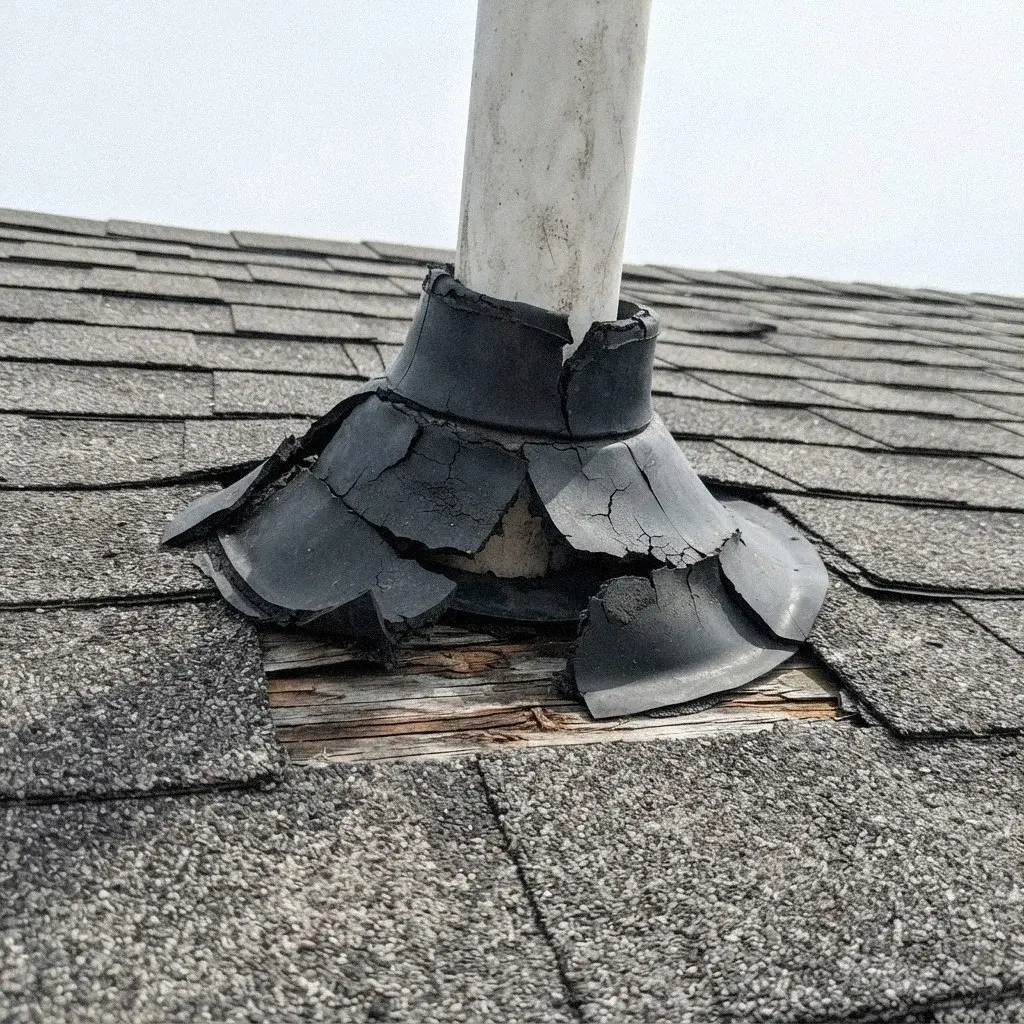
The Conditions Behind It
Bellevue's wet season runs long enough that a cracked boot rarely dries between storms, so the leak repeats every rain rather than showing up once and stopping. Homes near Kelsey Creek and the Bridle Trails tree canopy see slower drying, which speeds up rubber breakdown on shaded roof planes.
Composition shingle dominates Bellevue roofs, and every plumbing vent through that shingle field relies on a boot rather than a soldered collar. With this many penetrations per roof, a boot going bad on a home near Wilburton or Crossroads is a routine maintenance event, not a rare failure.
A quote for a Bellevue reroof should read as one number, not a number plus tax added later. Sales tax applies to labor as well as materials here, and a contractor cannot legally charge it on materials alone. Ask the pros we connect you with to show the tax separately so the total is not a surprise.
Quick Facts on This
- Location
- Around any plumbing vent pipe penetration through the shingle field, most often on sun-exposed or shaded slopes alike.
- Appearance
- A split, brittle, or curled rubber or plastic collar where it meets the vent pipe.
- Cause
- Sun exposure and repeated wet-dry cycling breaking down the rubber's flexibility over years.
- Progression
- Ceiling drywall stains, insulation saturation, and eventually decking delamination around the vent stack if the leak continues.
- If Ignored
- Left unrepaired it soaks decking and insulation near the penetration, and can spread to framing rot before a homeowner ever sees a ceiling stain in Bellevue.
- Best Window
- Fall, before the heaviest run of wet-season storms, is the practical time to check pipe boots in Bellevue, since a crack found dry is a simple swap while the same crack found mid-January is already an active leak into the attic.
- Roof Type
- an estimated $450–$2400
Why It Gets More Expensive
Cracked pipe boots get mistaken for flashing failure around a chimney or skylight, since both cause a ceiling stain that seems to travel from a roof penetration. The separating test is location: flashing sits flat against decking at a wall or curb, while a pipe boot wraps a round vent stack rising through the roof plane. Trace the stain's ceiling position back to the attic and sight up at the roof penetrations above it. If a round pipe passes through that spot, the boot is the likely source; if the stain sits under a chimney, skylight curb, or sidewall, it is counterflashing or step flashing instead.
What Fixing It Involves
A proper fix pulls the old boot free of the pipe, sets a new boot under the surrounding shingles per manufacturer overlap, and reseals against the pipe collar and the decking beneath. The licensed pros we connect you with also check the underlayment at that penetration for hidden staining.
Caulk smeared over a cracked collar buys a few dry weeks at best; it does not restore the boot's flex or its seal against the pipe. On an older Bellevue roof this delay lets moisture reach the fascia line or decking before anyone notices from the ground.
Wet-season damage tends to hide in the details: a valley that channels water where it shouldn't, a vent boot gone brittle, moss holding moisture against the surface longer than it should sit there. None of that shows from the ground. A closer inspection catches it while a repair is still cheaper than waiting for it to spread underneath.
Composition shingle or cedar shake: lifespan and upkeep compared
| Where you are now |
The usual recommendation |
|---|
| Cedar shake still shows up on plenty of older homes, and swapping it for composition shingle changes more than the look of the roof. Skip sheathing under shake behaves differently than solid decking under comp, and attic ventilation often needs a second look once the switch is made. It's a real job, not a simple swap. | A reroof quote should read as one number, not materials plus tax plus a surprise later. Sales tax applies to the whole job here, labor included, at the rate for where the roof sits, and a contractor cannot legally tax only the materials. Ask for that total in writing before signing anything. |
| Moss lift and worn flashing tend to show up gradually, not overnight. Bellevue's shaded, tree-covered lots keep roof surfaces damp long after storms pass, and that steady moisture works into valleys and seams before anyone notices a leak. Catching those early signs before the next wet stretch is what keeps a small repair from turning into a full reroof. | Moss on a shaded roof section isn't a look to tolerate until reroofing time. Left alone it holds moisture against the shingle and speeds up wear that would otherwise take years. The licensed pros we connect you with clear it carefully rather than pressure-washing granules loose, then look at what kept that section damp long enough for moss to take hold in the first place. |
| Getting quotes from several contractors is worth the extra hour it takes. Prices vary more than most homeowners expect, and so does what's actually included — cleanup, disposal, flashing work, warranty terms. A written estimate that spells out materials and scope protects you later, especially if a dispute over the work ever comes up. | Moss doesn't just sit on top of a roof, it holds moisture against the surface long after the rest of the neighborhood has dried out. That trapped water works into seams, lifts edges, and turns a small weak spot into a slow leak nobody notices until a ceiling stain shows up. Catching it early is cheaper than replacing sheathing later. |
What You Can Safely Do Yourself
From the ground or a window, a homeowner can watch for ceiling stains under vent runs and note which side of the roof faces shaded conifers. Climbing to inspect the boot collar itself, or checking the decking from the attic near the ridge or hip, is roof-level work for the licensed pros we connect you with.
How It Affects the Rooms Below
A cracked boot left alone lets water reach ceiling drywall and insulation, and prolonged dampness in an attic space can support mold growth on framing and insulation near the affected bay. Addressing the boot promptly keeps the moisture problem contained to a small, repairable area.
Curious What A Reroof Would Cost You?
Expect an estimated $450 to $2400 for cracked pipe boots here, with the pitch, the access and how much decking is sound doing most of the moving. Rot and soft decking here come from trapped moisture and poor attic ventilation, not insects, so pest treatment rarely belongs in a Bellevue reroof estimate. If the licensed pros we connect you with find soft sheathing near Bridle Trails or Somerset's shaded lots, expect a conversation about ventilation and skip sheathing, not a pest bill. pricing guide, and the service that handles this is Roof Leak Repair.