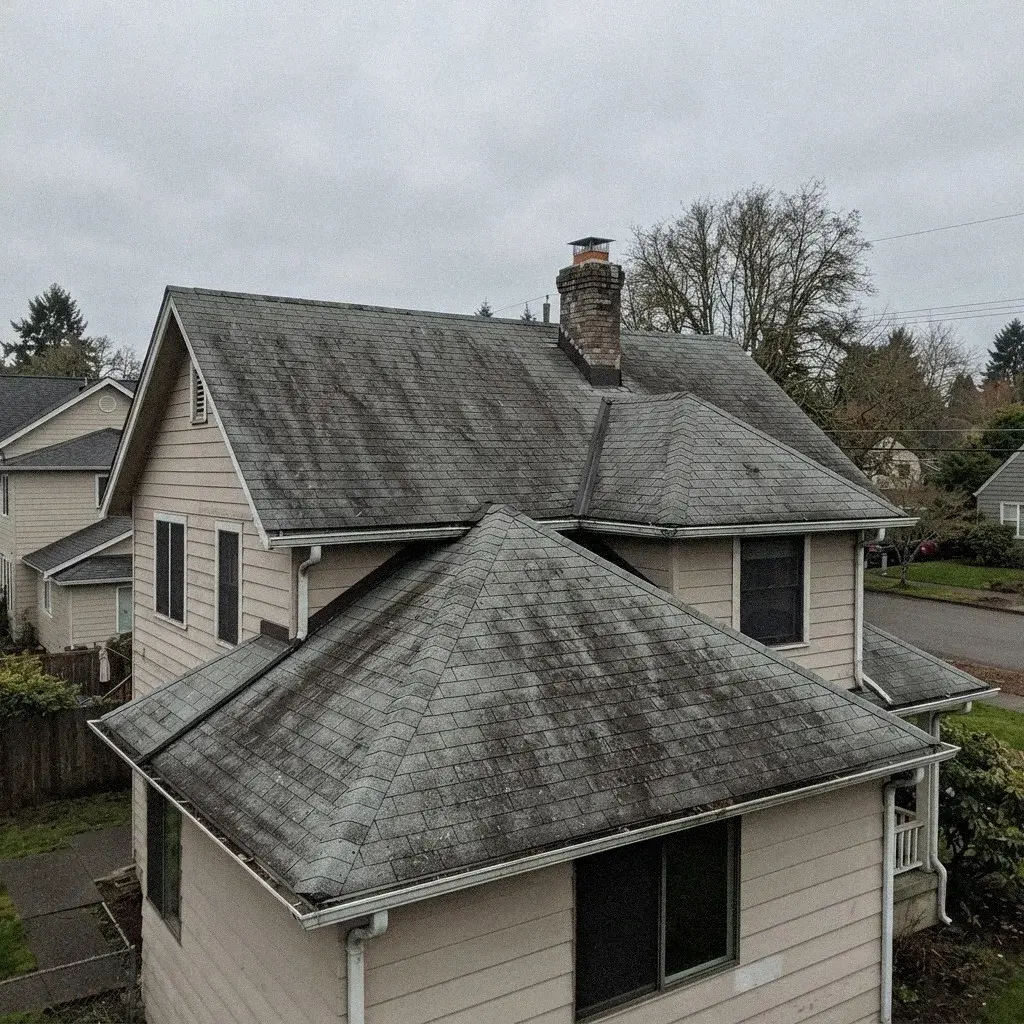
Why Eastside Roofs See This
Bellevue's long wet season keeps roof surfaces damp for days at a stretch, and mild temperatures never dry shingles out the way a hot, arid climate would, giving moss the steady moisture window it needs to take hold on shaded slopes.
Dense conifer cover across much of the city drops needle and cone debris into valleys and against the ridge, and that organic litter holds moisture against the shingle even after the rest of the roof has had a chance to dry.
A roof in Bellevue rarely fails all at once. It fails one damp week at a time, as moss holds water at the edges and flashing slowly gives way. The pros we connect you with look past the shingles to the decking underneath, since that is where a quiet leak turns into a real repair bill.
The Key Points
- Location
- Shaded north-facing slopes, valleys, and eaves under overhanging conifer canopy where the surface stays damp between storms.
- Appearance
- Green or gray-green cushioned moss clumps, or black-gray algae streaking that runs down from the ridge toward the eave.
- Cause
- Prolonged dampness from shade, poor drying, and organic debris caught at the ridge, hips, and valley that feeds growth on the shingle mat.
- Progression
- Slow by the month, faster across a full wet season, worst on older shingle mats with exposed granule loss.
- Damage
- Left alone, moss lifts shingle tabs, traps water against the substrate, and accelerates granule loss until the deck beneath starts to rot.
- Common Culprit
- Cleaning works best in the drier stretch from late spring into early fall, when the shingle surface has a chance to dry fully afterward; treating during the long wet season leaves the roof damp again within days and undercuts the work.
- Slope Access
- an estimated $400–$1600
What Another Wet Season Would Do
Moss and algae growth gets mistaken for granule loss on aging shingles, since both leave a mottled, discolored roof surface visible from the ground. Granule loss is bare, shiny asphalt showing through; moss and algae is a raised or streaked coating sitting on top of the shingle mat itself. The test is touch and texture from a ladder: moss lifts away in a cushioned mat and algae wipes as a dark stain, while granule loss reveals smooth, granule-free asphalt underneath that no amount of cleaning will restore or change in appearance.
The Fix, in Order
A soft wash with the correct low-pressure method and an appropriate cleaning solution removes moss and algae without stripping granules, and clearing needle debris from the valley and eave afterward keeps the surface drying out between storms going forward.
Pressure washing may look like a fix, but it drives water under tabs and around pipe boots and can strip granules outright, which is treating the symptom while quietly setting up sealant failure and delamination underneath that shows up as a leak later.
A roof here fails slowly. Wet-season weeks keep shingles from ever fully drying, and moss takes hold before anyone notices a problem. The licensed pros we connect you with check flashing, valleys, and gutters for the slow leaks that show up as a stain long after the water first got in.
Metal or low-slope membrane: which roofs each one suits
| What the roof is doing |
The sensible option |
|---|
| Comp shingle ages differently on a shaded slope than on one that catches sun most of the day. Moss holds moisture against the surface and lifts edges long before the shingle itself wears out, which is why two roofs of the same age can need very different work. A pro who looks at yours in person can tell which stage you're actually at. | Wet-season damage rarely announces itself. Water works into flashings and valleys over weeks of overcast weather, moss lifts shingle edges, and gutters clogged by fall debris back up against the roofline. The pros we connect you with check attic ventilation and decking condition, not just the surface, before pricing any repair or reroof. |
| Shade and moisture do more damage than age alone in this climate. A roof under heavy tree cover can wear out years before an identical one in open sun, simply because it never fully dries between rains. The licensed pros we connect you with know how to read that difference on sight. | What shortens a Bellevue roof isn't one storm but the slow accumulation of wet weeks with no real drying time between them. Moss lifts shingle edges, valleys clog, flashing works loose, and the damage compounds quietly for years before a homeowner sees a stain on the ceiling. Catching that pattern early is the whole point of a routine roof check. |
| Moss is not just an appearance problem. It holds water against shingles, lifts edges, and shortens the life of a roof that would otherwise last for years. Left alone through several wet seasons, it turns a simple cleaning job into a full section of damaged decking. Catching it early keeps the fix small. | Every roof problem has a cause, not just a symptom. Trapped moisture, blocked ventilation, and shaded surfaces that never fully dry all shorten a roof's life in their own way. The licensed pros we connect you with trace the actual source before proposing work, so a repair addresses what's happening under the surface, not just the spot that's visibly failing. |
Where Ladder Work Turns Dangerous Fast
Homeowners can scan north-facing slopes from the ground or a window for green or black patches, especially under overhanging trees. Scraping, pressure washing, or climbing onto a wet, moss-slick roof is unsafe without fall protection and belongs with the licensed pros we connect you with.
What It Does Indoors
Moss itself is not commonly described as a health hazard in the facts here, but the trapped moisture it holds against the decking creates the damp, humid conditions in which mold on sheathing and attic surfaces can take hold over time.
Want A Straight Answer On Your Roof?
A guide figure for moss and algae growth locally is an estimated $400 to $1600, which is a band rather than a quote. Rot and soft decking here come from trapped moisture and poor attic ventilation, not insects, so pest treatment rarely belongs in a Bellevue reroof estimate. If the licensed pros we connect you with find soft sheathing near Bridle Trails or Somerset's shaded lots, expect a conversation about ventilation and skip sheathing, not a pest bill. pricing guide, and the service that handles this is Moss Removal & Roof Cleaning.