Why Bellevue Roofs Age Before Their Time
Bellevue roofs rarely fail from one storm. They wear out from months of damp shade, clogged valleys, and weak flashing details that never get a real chance to dry between rains.
Read article
Clear gutters and downspouts, with guard options that cut how often you climb up there.
Across King County, whether you're in Bridle Trails, Crossroads, Eastgate, or elsewhere around Bellevue, gutter cleaning & gutter guards is worth arranging with somebody who works on this housing stock rather than a generic plan. Foundation type, soil and building age all change what has to happen first.
For a private home, residential roofing sets out what a visit involves. For a shop, office, or tenanted building, commercial roofing is the right starting point.
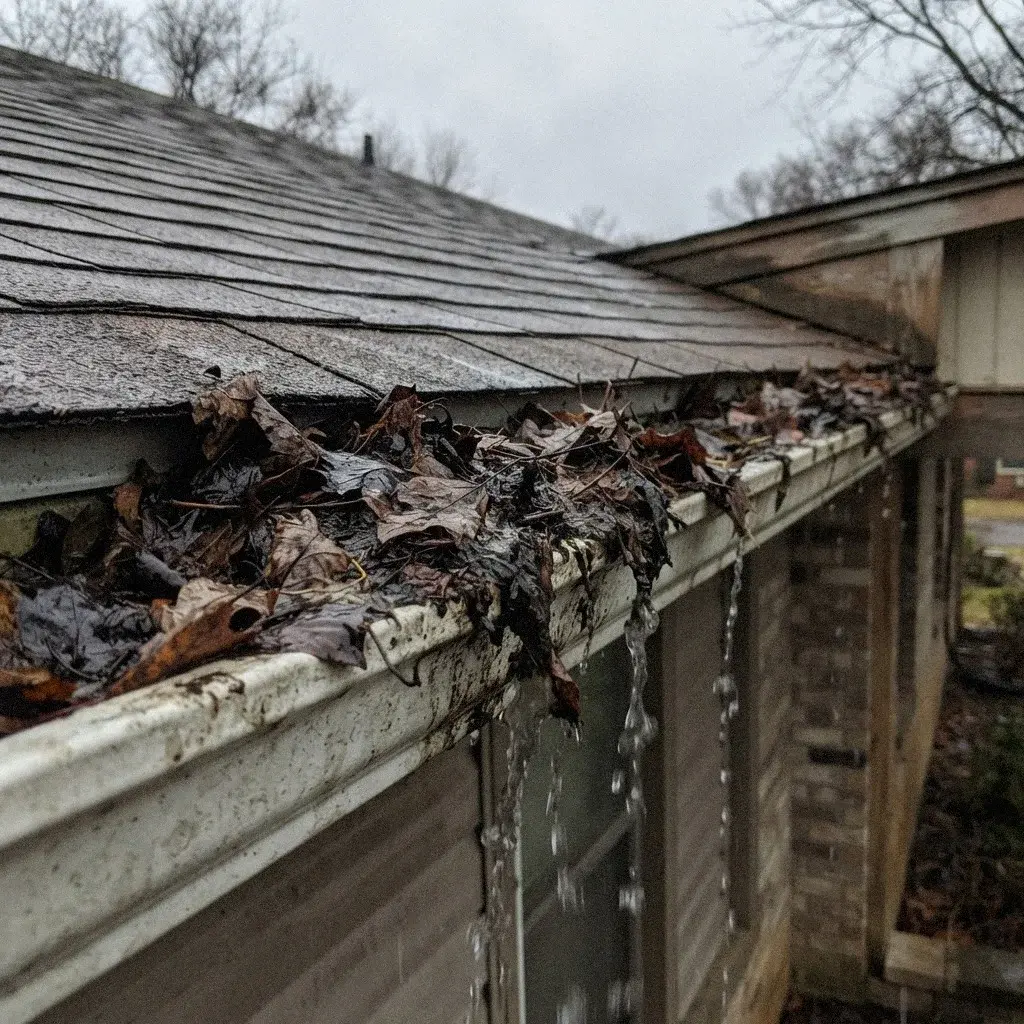
Clogged gutters usually announce themselves before a homeowner climbs a ladder to check. Water tracks down the siding in a stain below a low spot, or it sheets over the front edge during a hard rain instead of running through the downspout. Around Bellevue, needle debris from Douglas fir and western red cedar packs into the trough faster than leaf debris alone would, so a gutter can look shallow and still be fully blocked underneath a mat of needles and grit.
Standing water in the gutter itself is a sign the slope or the outlet is blocked, not just the run. Reach in after a dry stretch and if water is still sitting there, it usually means the downspout is packed and needs a flush rather than a surface scoop. Left alone, that trapped water works under the shingle edge and against the fascia, which turns a clearing job into a repair job over a season or two.
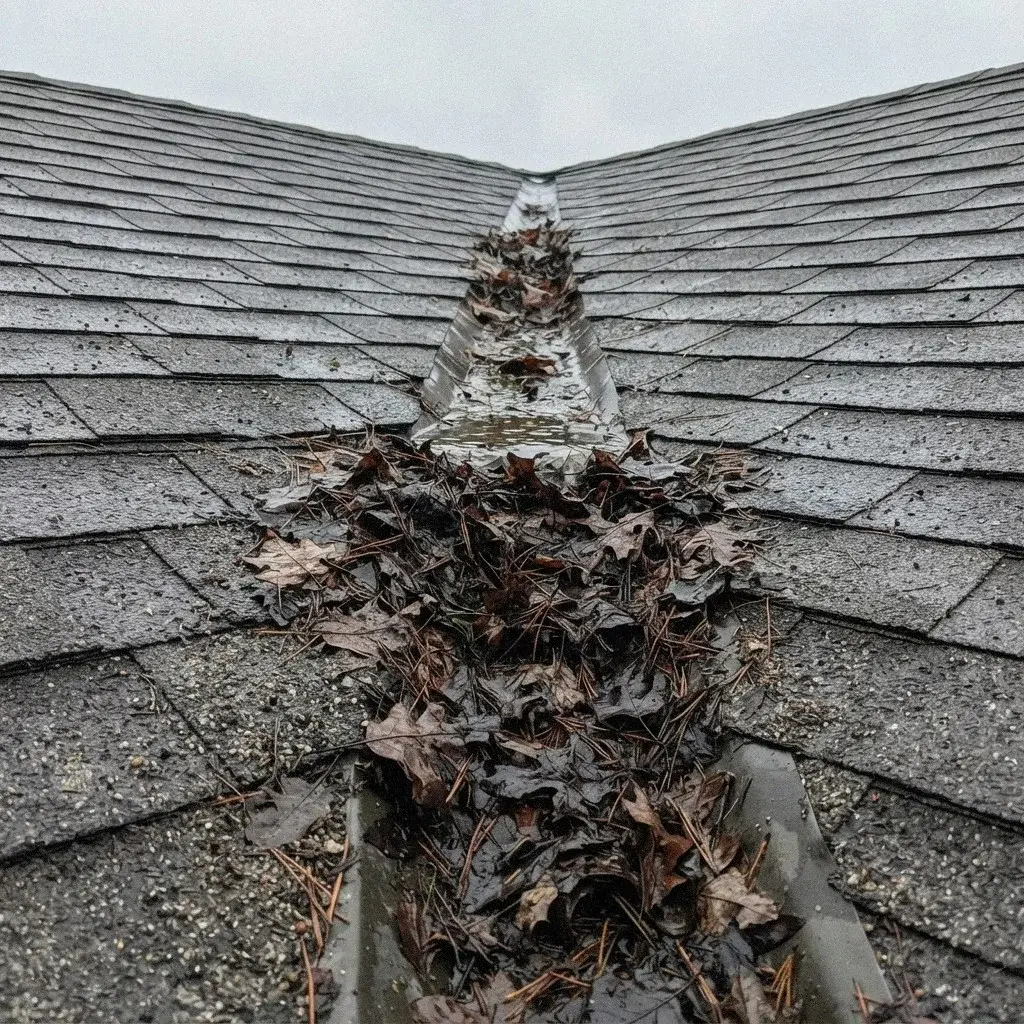
Seed pods and roof valley debris build up in the same places every year, usually where two roof planes meet or where a branch hangs close over the eave. On a lot near mature conifer cover, that debris arrives faster than most homeowners expect, and a gutter that looked clear in spring can be packed solid by the time the wet season sets in over Bellevue in October.
The pros clear each run by hand, removing needle debris, seed pods, and shingle grit down to bare metal, checking corners and end caps where blockages tend to start.
Every downspout gets a water test from the top, and any spot where water backs up or slows gets flushed or cleared from the nearest joint until it drains freely.
Roof valleys and any low spots get checked for debris that did not wash down naturally, since a blocked valley can overflow onto the roof deck instead of into the gutter.
If guards are wanted, the pros go over micro-mesh, leaf screen, and hood-style options for the home's actual tree cover, since no single guard fits every roofline the same way.
Bellevue sits under enough conifer and deciduous cover that gutters fill with needle debris, seed pods, and shingle grit well before most homeowners expect, and the region's long wet season gives clogged sections no chance to dry out between storms. On hillside lots near Somerset or Newcastle, water that overflows a blocked gutter runs straight down a slope instead of away from the house, which is a drainage problem here more than a gutter problem.
Cleaning frequency in Bellevue depends more on what is planted or growing over the roof than on the calendar. A house under heavy conifer canopy, the kind common on lots near Cougar Mountain, Lakemont, or Bridle Trails, tends to need clearing twice a year at minimum, once after the bulk of autumn leaf and needle drop and again before the heaviest winter rain sets in. A more open lot with little overhang can often go longer between visits.
A downspout blockage is usually diagnosed with a water test: run a hose at the high end of the run and watch where the water backs up or refuses to move. In Bellevue's long wet season, a downspout that stays clogged does not just overflow at the gutter, it directs water straight down against the foundation or across a sloped yard, which matters more here than in a flatter, drier place.
Here is roughly what gutter cleaning & gutter guards runs locally. Treat it as a guide — the property itself decides where inside the range you land.
| Written Scope | Tax Treatment | Permit Status |
|---|---|---|
| Licensed here means registered with the state, bonded, and carrying liability insurance. That status is checkable before anyone sets foot on the roof, and it matters more than a friendly sales pitch or a truck with a logo on it. | Visual check only, roof still in decent shape — no repairs, no climb on steep pitch | an estimated $120–$475 |
| Insurance protects you two ways: it covers damage if something goes wrong during the job, and it keeps an injured worker's medical bills off your homeowner's policy. Ask to see current proof, not just a claim that coverage exists somewhere. | Tear-off, new flashing and valleys, standard shingle or shake — no structural repair | an estimated $175–$650 |
| A bond is not the same as insurance. It's a smaller financial backstop meant to cover unfinished or defective work. Confirming both bond and insurance status takes a few minutes and avoids a much longer cleanup later. | Full reroof: complete tear-off, new decking where soft, flashing and valleys redone | an estimated $230–$900 |
| Unlicensed work can still look competent on the surface, until a warranty claim has nowhere to go or a lien shows up after you thought the job was paid for and finished. Verification exists precisely because appearance and standing aren't the same thing. | Full tear-off, disposal, new decking as needed, no repaint or gutters | an estimated $315–$1300 |
The rate a roofer charges depends on where the work happens, not where the company is based. Confirm the figure quoted matches the current local rate before signing, since combined rates shift by jurisdiction and change from one quarter to the next.
Homes near heavy conifer canopy, like the tree-lined lots around Bridle Trails and Cougar Mountain, generally need gutters cleared twice a year, once in late fall after leaf and needle drop and once in late winter. A property shaded by tall Douglas fir or western red cedar with cones and needle debris feeding the roof valleys year-round may need a mid-summer check too, especially if downspouts have overflowed before.
Micro-mesh screens block needle debris, seed pods, and shingle grit, which are the fine material that packs into open K-style gutters under Bellevue's conifer cover. Hood-style covers shed larger leaves and twigs but let finer grit and needle debris ride the water over the lip in a hard rain. No guard stops buildup completely, so gutters with guards still need a periodic check rather than routine hand cleaning.
Standing water pooling in the gutter trough near the downspout opening, or water sheeting over the gutter edge during rain instead of draining down, both point to a blockage. The pros we connect you with run a water test, flushing the downspout from the top, and clear the obstruction with a plumber's snake or by disassembling the elbow joint if the clog sits lower in the run.
Yes, most guard and screen products are designed to attach to existing gutters rather than requiring new gutter runs, and this is common for homes around Somerset and Newport Hills with mature trees overhanging the roofline. The pros we connect you with can measure the existing gutter profile and downspout locations first to confirm which guard type fits without altering the roof's drainage path.
Roof valley debris is a different problem from the gutter itself, since needles and seed pods can pack into the valley above the gutter line before they ever reach the guard. Guards help at the gutter edge, but a valley clogged with debris still needs to be cleared by hand as part of the same visit, particularly on homes near Lake Hills Greenbelt with dense overhead cover.
An overflow with a clear-looking trough usually means the blockage is inside the downspout, not the gutter run, or the gutter has pulled away from its slope and no longer carries water to the outlet. Homes near Mercer Slough with soil that shifts on wet ground sometimes see gutters sag out of pitch, which a hand check during cleaning can catch before it becomes standing water against the fascia.
Roof questions in Bellevue usually come down to material and moisture, not storm damage. Composition shingle covers most houses, cedar shake shows up as a strong second, and low-slope sections near Mercer Island or Yarrow Point often carry metal instead. What a roof needs depends on which of those it already has, so a straight answer means someone looking at your actual roof, not a guess from a form.
A roof problem in one part of town rarely matches a roof problem somewhere else nearby, even a short drive off Bellevue Way or across from a park like Kelsey Creek. Slope, shade, and age all change what a roof needs. The licensed pros we connect you with look at your actual roof before naming a cause or a fix.

Bellevue roofs rarely fail from one storm. They wear out from months of damp shade, clogged valleys, and weak flashing details that never get a real chance to dry between rains.
Read article
Before the long wet season settles over Bellevue, a roof benefits from a short walkaround done in the right order. This piece lays out what to clear, what to check, and when to book it.
Read article
Most Bellevue roof leaks trace back to a short list of weak points rather than the shingles themselves. This is a ranked look at where water actually gets in, from valleys and pipe boots to sidewall flashing and exposed fasteners.
Read articleReading about this service is a fine start, but every Bellevue roof wears differently depending on shade, pitch, and age. The details on this page describe what the work generally involves; they cannot tell you whether your roof needs it right now. The licensed pros we connect you with can look at the actual conditions - moss, flashing, gutter runoff - and tell you honestly whether this is the right job or something else is the real problem first.
Call (425) 380-0932