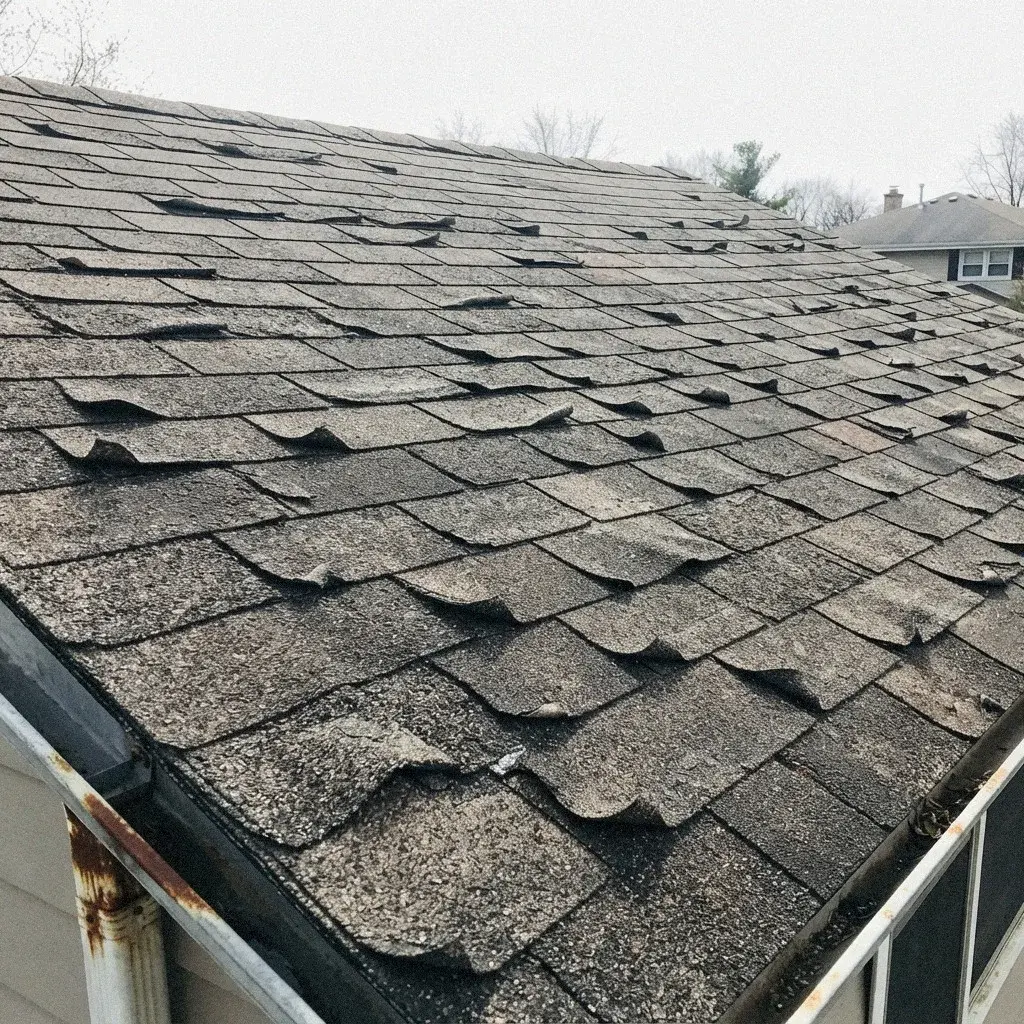
How Asphalt Shingles Age Over Time in Bellevue, WA
Every composition roof in Bellevue moves through predictable stages between installation and end of service life.
Rated life is a lab number; achieved life is what Bellevue's wet, shaded roofs actually deliver. Moss lift, repeated wetting, and sealant strip failure typically cut real service life below the rated years printed on the wrapper.
Rated Life Versus Achieved Life
A shingle's rated life is a laboratory number, and the roof over a Bellevue house rarely reaches it. Manufacturers test accelerated aging under controlled heat and UV cycling, then print a number like twenty-five or thirty years on the wrapper. Achieved life is what actually happens once that same shingle sits above Lake Washington humidity, shaded conifer canopy near Bridle Trails, and months of standing damp. The gap between the two numbers is where most Bellevue roofing decisions actually live, and it is rarely small.
Three-tab shingles and architectural shingles age on different curves, and the difference shows up years before either fails outright. Three-tab shingles are thinner, single-layer products with less mass to resist granule loss and less flexibility to survive repeated wetting and drying. Architectural shingles laminate two layers together, which slows moisture penetration and holds granules longer under the same Bellevue weather. Neither is immune to the region's real aging drivers, but a three-tab roof on a Somerset or Newport Hills home typically shows wear on a shorter timeline than a laminated one installed the same year.
Rated life numbers come from accelerated lab testing, not from a Bellevue roof. A shingle stamped for thirty years assumes even sun exposure and a dry attic, conditions that rarely hold on a shaded lot near Bridle Trails or Somerset. Conifer canopy keeps sections damp long after a storm passes, and that extra moisture load pulls achieved life well below the printed number. The rating is a lab ceiling, not a promise for any specific roof in this city.
What Happens Decade By Decade
Granule loss starts at the sealant strip and the shingle edges, the parts most exposed to repeated wetting and drying under Bellevue's long overcast stretches. Once granules thin, the asphalt mat underneath takes direct ultraviolet exposure it was never meant to carry alone, and the surface hardens and turns brittle faster from that point forward. Homes along Coal Creek Parkway or up toward Cougar Mountain, where moss holds water against the surface, tend to show this pattern earlier than open, sun-exposed roofs elsewhere in the city.
By the second decade, thermal cycling has done real work. Shingles expand slightly in warm afternoons and contract in cool nights and over winter, and that repeated movement fatigues the asphalt mat and stresses the sealant bond long before it breaks outright. Nail pop often surfaces here too, as framing settles and shingles work loose around fastener heads, showing as small raised bumps or circular cracks. Homes in exposed spots like Cougar Mountain hillsides or open Sammamish-facing slopes tend to show this cycling fatigue earlier than roofs tucked under heavier tree cover.
- Years one through five: sealant strips finish curing and bond tabs down against wind. Color looks uniform, granules sit tight, and the roof shows little more than settling dust and early moss spotting on shaded slopes near heavy fir or cedar canopy.
- Years six through twelve: moss and lichen start gaining a foothold on north-facing sections, especially under overhanging conifers common in Bridle Trails and the Cougar Mountain area. Granule loss becomes visible in gutters after the first hard rains of the wet season.
- Years thirteen through eighteen: thermal cycling and repeated wetting begin showing as light cupping or clawing at tab edges. Sealant strips that were compromised by trapped moss moisture start losing bond, and nail pops appear where fasteners backed out during earlier seasonal movement.
- Years nineteen through twenty-four: cracking and splitting show along tab edges and in valleys where water sits longest. Curling becomes more pronounced on shaded roof faces, and granule loss accelerates once the fiberglass mat starts taking direct wetting.
- Years twenty-five and beyond: blistering, widespread cupping, and bare patches signal the shingle is past useful protection. Flashing and valley leaks become more frequent during the long stretch of wet months from fall into spring.
- End of service life is not one event. It is the point where granule loss, curling, and failed sealant strips combine so the roof no longer sheds water reliably during Bellevue's wet season, regardless of the number printed on the original wrapper.
Granule Loss And Sealant Strip Failure
Granule loss runs in stages rather than as one steady decline. Early loss is cosmetic, just the manufacturing excess washing off in the first rains. Mid-life loss exposes the asphalt coating beneath in patches, usually starting at high-flow points like valleys and eave edges where water moves fastest. Late-stage loss bares the fiberglass mat itself in spots, and that mat has no UV protection once exposed, so degradation accelerates sharply from there. A homeowner checking gutters near a Bellevue property line will often find the clearest evidence of which stage a roof has reached sitting right in the downspout runoff.
Sealant strip failure is separate from granule loss but often gets blamed on it. The strip can lose its bond from age, from repeated freeze-thaw movement, or from being disturbed during a windstorm before it ever gets the chance to re-seal. Once sealed shingles work loose from each other, wind uplift becomes possible even at moderate speeds, since the whole point of the strip is holding tabs flat against the course below. Bellevue's winter Pacific frontal systems provide exactly the kind of sustained gusting that finds these already-weakened bonds rather than causing the failure outright.
- Install quality sets the ceiling on achieved life. Shingles nailed too high, too low, or with the wrong pattern lose wind uplift resistance and sealant strip contact, which shows up early as lifted tabs during winter windstorms off the Pacific.
- Attic ventilation controls how much moisture and heat move through the roof deck from underneath. Poor ventilation traps warm, moist air against the shingle mat, which speeds blistering and shortens the life of the sealant strip from below.
- Drainage at valleys, flashing, and gutters decides how long water sits on the shingle surface. Clogged gutters or undersized downspouts on homes near Kelsey Creek or Coal Creek Natural Area let water back up under tabs during long rain stretches.
- Roof pitch and shading interact with all of the above. Low-slope sections and roofs shaded by dense Douglas fir or western red cedar canopy dry slower after every storm, which is why identical shingles on the same Bellevue street can age at different rates.
Warping Patterns: Cupping, Clawing, Curling
Cupping, clawing, and curling describe three related but distinct deformations, and distinguishing them matters for reading a roof's age. Cupping is the edges of a shingle turning upward while the center stays flat, usually from moisture trapped underneath. Clawing is a more irregular lift, often where granule loss has been uneven across the tab. Curling is the broader upward bending, typically from UV degradation drying and stiffening the asphalt on the exposed face while the underside stays relatively supple. All three point toward a shingle nearing the end of its flexible life.
Cracking and splitting come later and mean something different than curling. A cracked shingle has lost enough asphalt plasticity that thermal cycling now fractures it outright instead of just flexing it, and splits often follow the line of least resistance through weakened granule coverage. Blistering is a related but separate defect, showing as small raised bubbles where trapped moisture or manufacturing gas pockets expand under sun and then rupture, leaving a pit that exposes the mat below. On a Wilburton or Eastgate roof, blistering tends to cluster on slopes that get long afternoon sun with minimal cross-ventilation underneath.
| Age Range | Typical Condition | What to Watch |
|---|---|---|
| Years 1 to 5 | Edges turn upward, tab stays flat | Trapped moisture, poor attic airflow |
| Years 6 to 12 | Edges cup while granules bunch at center | Aged fiberglass mat losing flexibility |
| Years 13 to 20 | Whole tab bows upward from repeated wetting | Long wet season, sealant strip failure |
| Years 20 and beyond | Raised bubbles that later crack open | Trapped gas or moisture under mat |
| Cracking and splitting | Straight-line breaks through the tab | Thermal cycling over many seasons |
Signs A Roof Has Reached End Of Life
Install quality sets the ceiling on how long any shingle lasts, regardless of its rated life. Fastener placement, nailing pattern, and whether shingles were laid tight to the manufacturer's exposure lines all affect how evenly stress distributes across the roof for its whole life. A roof installed slightly off-spec on a Bellemead or Eaglesmere home might look fine for years, then fail unevenly and early because a portion of its courses were never properly locked down. This is one reason two roofs of the same age and material can be in visibly different condition.
Ventilation and drainage shape the aging curve as much as the shingle itself. Poor attic ventilation traps heat and moisture against the underside of the deck, which accelerates mat degradation from below while UV works the surface from above - a double load few shingles handle gracefully for their full rated term. Clogged valleys and undersized gutters near conifer-heavy lots in Bridle Trails or the Cougar Mountain area let water sit against shingle edges longer than it should, which speeds cupping and granule loss in exactly those spots. Two identical roofs with different ventilation and drainage conditions will not age at the same rate.
When a Roof Reaches End of Service Life
End-of-life indicators rarely arrive as a single dramatic sign. They accumulate: granules collecting steadily in gutters, tabs that have lost their curl memory and stay lifted after a storm, sealant strips that no longer hold down in wind, and bald patches where mat is visible in more than isolated spots. On a Bellevue roof, the combination of these signs across multiple slopes, rather than any one symptom in isolation, is what separates a roof that still has working years left from one that has quietly crossed into its final stretch.
Reading these signs accurately takes walking the roof or getting a close look with binoculars from the ground, not just glancing up from the driveway on Bellevue Way or a side street in Northeast Bellevue. Granule loss, sealant failure, and deformation each tell a slightly different part of the story, and a roof can be well past its practical service life in one section while looking sound in another. That uneven aging is normal, and it is exactly why a single visible flaw should prompt a fuller look rather than an isolated patch.
Signs Your Shingles Are Aging
- Three-tab shingles generally carry a lower rated life than architectural shingles, and their thinner profile shows curling and cracking sooner once sealant strips start failing under Bellevue's repeated wetting cycles.
- Moss is a mechanical threat, not a cosmetic one. It lifts shingle edges, holds water against the fiberglass mat, and breaks sealant strip bonds faster than sun exposure ever would in this climate.
- Granule loss in the first few years is normal shedding of loose factory granules. Granule loss after year ten, especially in patches, points toward mat exposure and accelerating wear.
- Cupping and clawing are early curling stages, not separate problems. Cupping bends tab edges up first; clawing twists the tab further and usually means moisture has been working underneath for a while.
- Nail pops come from framing movement and thermal cycling, not defective nails alone. A popped nail creates a small entry point that lets water reach the underlayment long before the surrounding shingle looks worn.
- A roof past end of service life does not always leak everywhere at once. It often fails first at valleys, flashing, and low-slope transitions, where water has the least chance to run off before finding a gap.
Frequently Asked Questions
How long do asphalt shingles actually last in Bellevue?
Rated life is a lab number from accelerated testing; achieved life is what a shingle actually reaches on a Bellevue roof, and the two often differ by years. Local conditions - shade from conifer canopy, ventilation quality, install care, and how much standing damp a slope holds through the wet season - determine where in that range a given roof lands, more than the number printed on the wrapper.
What is the difference between rated life and real life?
Not usually. Bellevue's shingle failures come from moss lift, trapped moisture under debris, and sealant strips that lose bond after years of wetting and drying, not from heat or UV breakdown. Shingles under conifer canopy in Bridle Trails or Somerset often show curling and granule loss well before a sun-exposed roof across town.
Why are my shingles curling at the edges already?
Rated life assumes ideal installation, ventilation, and drainage. In Bellevue, shaded roofs near Cougar Mountain or Lakemont stay damp longer, and moss works under tabs before the shingle reaches its rated years. A 30-year shingle installed with poor ventilation can show end-of-life signs a decade early.
Does moss shorten how long my shingles last?
Granule loss exposes the asphalt mat to direct wetting and speeds up cracking, but it is one sign among several. Cupping, clawing, and lifted edges from moss usually show up alongside bare patches. Losing granules near valleys or in gutters after storms off the Pacific is worth a closer look, not automatic replacement.
Can bad attic ventilation age shingles faster?
Cedar-to-composition conversions are common on older Bellevue homes, especially where skip sheathing was original. The conversion changes roof weight and often requires solid decking and a ventilation review before the new shingles go down. It is a routine job for the licensed pros we connect you with, not a rare undertaking.
Not Sure What Decade Your Roof Is In?
Not sure which stage your Bellevue roof is in? The licensed pros we connect you with can walk the slopes and tell you.
Call (425) 380-0932