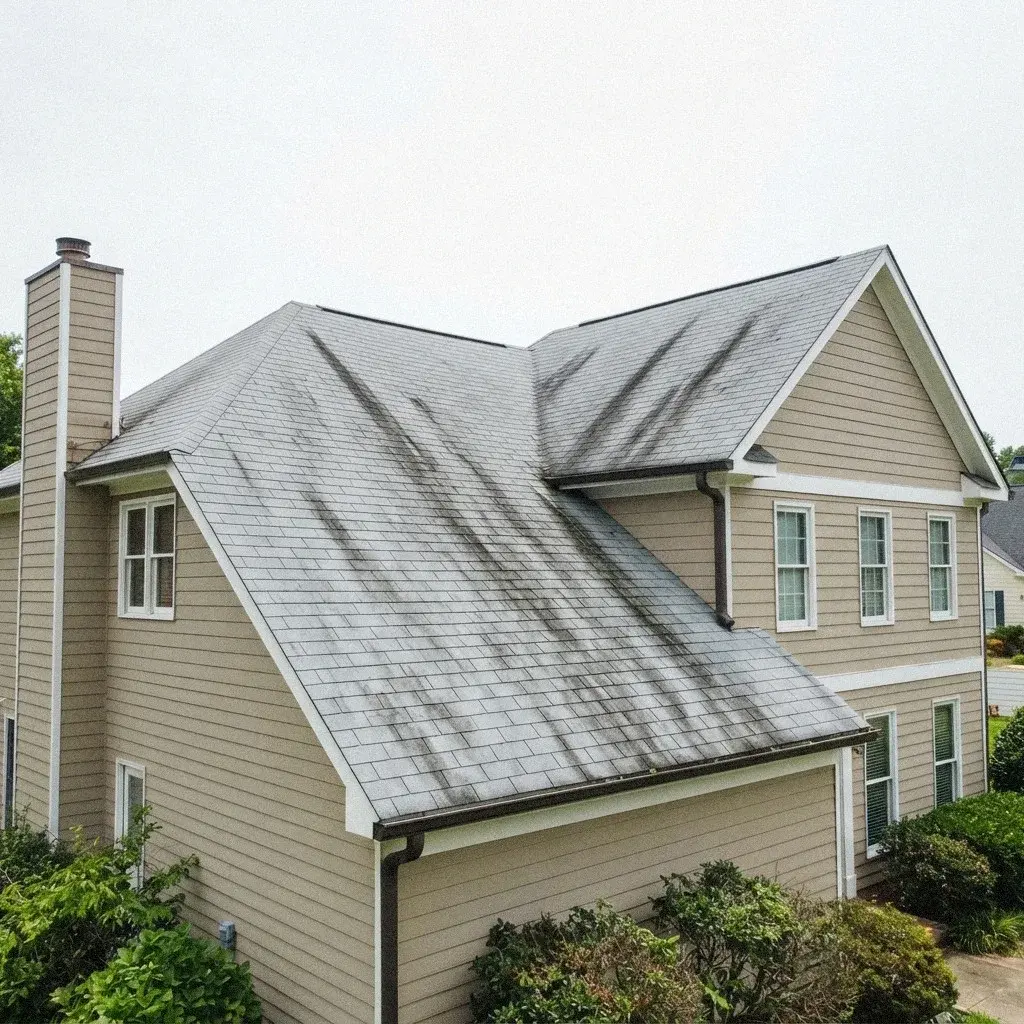
Moss, Algae, and Lichen: The Full Guide in Bellevue, WA
Why growth spreads on shaded Bellevue roofs, how it damages shingles, and the treatments that actually work.
Moss and algae grow on Bellevue roofs because shaded, damp shingle surfaces stay wet for days after rain. Moss lifts shingle edges and holds moisture against granules; algae streaking is cosmetic. Soft washing and zinc or copper strips control both without pressure-washing damage.
How Moss, Algae, and Lichen Differ
Moss growth on Bellevue roofs is not random. Gloeocapsa magma and other algae species produce visible streaking on north-facing slopes, while true moss forms a thicker mat that holds water directly against the shingle surface. Lichen shows up less often but signals a roof section that has stayed damp for years rather than weeks. Each organism behaves differently, spreads by spore rather than by root, and needs a specific combination of shade and moisture retention to establish. Understanding which one is actually on a roof in Bridle Trails or Somerset changes what treatment makes sense.
Shade load is the variable that decides where moss and algae take hold first. A roof plane shaded most of the day by overhanging Douglas fir or western red cedar dries slower after every rain, and in Bellevue that slower drying compounds across a wet season that runs from October into May. Bridle Trails, the Cougar Mountain and Lakemont area, and Somerset carry the heaviest conifer canopy in the city, and homes there see moss establish years before a similar roof in a more open, sun-exposed part of Bellevue would show the same growth.
Moisture retention under a moss mat is different from a simple wet spot. Once moss anchors itself to the granule surface, it keeps a thin layer of water against the shingle continuously, even between storms, rather than letting the surface dry the way an unobstructed roof plane does. That constant dampness is what separates a shingle with light algae streaking, which is mostly cosmetic, from one carrying an established moss colony, which is doing ongoing physical work on the roofing material underneath it.
Shade, Moisture, and Why Growth Spreads
Granule adhesion is the first casualty of sustained moss contact. The mineral granules on a composition shingle are embedded in asphalt to shield it from ultraviolet exposure and to shed water, and a moss root structure works into the gaps between granules as it grows. As moss expands and contracts with wetting and drying cycles, it loosens the asphalt's grip on those granules, and granule loss shows up as bare, darker patches that accelerate wear on that section of roof independent of the roof's actual age.
Shingle edge lifting follows once moss has established for a season or more. Moss growing under a shingle tab or along a ridge line pushes the shingle up slightly as it thickens, breaking the seal between overlapping courses. That lifted edge lets wind-driven rain get underneath the shingle instead of running over it, and it's a mechanical problem, not a staining problem: a roof with lifted edges from moss can leak years before it would have failed from ordinary wear, and the damage often shows first at ridges and eaves.
- Moss is a small, rootless plant that spreads by spore and needs sustained moisture to establish. It does not draw nutrients from the shingle itself, but it depends on the shingle surface staying wet, which is exactly what long stretches of Bellevue's wet season provide on shaded slopes.
- Algae, mainly the organism gloeocapsa magma, is a single-celled organism that colonizes the granule surface and produces the dark streaking seen on many north-facing roofs in Bellevue. It spreads by spore carried on wind and by birds, and it thrives on limestone filler in the granules.
- Lichen is a combined organism, a fungus and an alga living together, and it behaves differently from moss or algae because it anchors into the shingle surface with root-like structures. It is slower to establish but harder to remove once it has taken hold on a roof.
- Shade load describes how much of a roof section sits under tree cover for how many hours a day. Bellevue's dense Douglas fir, western red cedar, and hemlock canopy, heaviest in Bridle Trails and Somerset, creates the shade load that keeps shingles from drying between storms.
- Moisture retention is the property that decides whether spore can establish at all. A shingle that dries within a day after rain rarely grows moss, while one shaded most of the day through Bellevue's long wet season can stay damp for a week or more.
- North-facing slopes and roof sections shaded by overhanging conifers see the least direct sun of any part of a Bellevue roof, so they hold moisture longest after each storm. This combination of shade and moisture retention is why moss and algae concentrate there rather than spreading evenly.
How Growth Damages a Shingle Roof
Pressure washing is the wrong tool for moss and algae on a composition shingle roof, and it's worth explaining why rather than just saying so. A high-pressure stream strips granules along with the moss, taking the shingle's UV protection with it, and it can drive water up under shingle tabs and flashing at valleys in ways that cause the exact leak the cleaning was meant to prevent. Low-pressure rinse methods exist because they remove growth without removing the roofing material it was growing on.
Soft wash treatment relies on a sodium hypochlorite solution applied at low pressure, left to work on the organism itself rather than blasted off mechanically. The chemical breaks down moss, algae, and lichen at the cellular level, and a low-pressure rinse afterward clears the dead growth without abrading the shingle surface. This is slower than pressure washing and depends on getting concentration and dwell time right for the specific growth present, which is why it's treated as a job for the licensed pros we connect you with rather than a homeowner project with a garden hose attachment.
- Moss growing under a shingle tab lifts the edge as it thickens, breaking the seal that keeps wind-driven rain out. Once an edge lifts, water works underneath more easily on the next storm, and the lifting tends to worsen rather than heal on its own.
- Granule adhesion weakens wherever moss or lichen roots into the shingle mat, and granule loss exposes the asphalt layer beneath to sun and weather. This is separate from algae streaking, which sits on the surface and does not affect granule adhesion the same way.
- Shingle edge lifting from moss growth is most visible along ridge lines and at the bottom edge of a slope, where moss tends to grow thickest because water collects there last before running off. These are the spots worth checking first on a shaded roof.
- None of this damage happens quickly. Moss and lichen take a full wet season or more to establish enough growth to lift an edge, which is why a Bellevue roof inspected once a year, ahead of the dry window from late spring into early fall, usually catches it before real damage sets in.
Moss, Algae, and Lichen Compared
Zinc strip and copper strip installation is a preventive measure, not a cure for growth already established. Metal strips mounted near a ridge line release metal ions that wash down the roof plane with every rain, and those ions are hostile to moss and algae regrowth on the shingle surface below the strip. They don't clean anything already there, and their effect fades with distance down a long slope, but on a roof that's been treated once, a zinc or copper strip can meaningfully slow how fast growth comes back.
Algae-resistant shingle is the manufacturing-side answer to the same problem. These products embed copper or other algae-resistant compounds directly into the granules during manufacturing, so the whole shingle surface carries some resistance rather than relying on runoff from a single strip near the ridge. They cost more than standard composition shingle, and they don't make a roof immune to moss in a heavily shaded, wet location, but on a reroof in a neighborhood like Bridle Trails, the upgrade is worth weighing against the standard product.
| Organism | Appearance | Shingle Effect |
|---|---|---|
| Moss growth pattern | Thick green cushions, holds water | Damage mechanism |
| Algae streaking pattern | Green cushiony mats, thickest on shaded slopes | Holds water, lifts shingle edges over time |
| Gloeocapsa magma (algae) | Black-gray streaking, worst on north faces | Feeds on granules, dulls reflective coating |
| Moisture retention risk | Crusty gray-green patches, flat and rooted | Bonds tightly to granules, pulls them loose |
| Typical removal approach | Soft wash or low-pressure rinse | Avoids granule and shingle edge damage |
Maintenance Intervals That Prevent Regrowth
Zinc and copper strips slow future moss growth: rain running over the metal carries trace ions downslope that inhibit spore germination, though the strip itself only protects the shingle courses beneath and downhill from it. A single ridge strip on a long, heavily pitched roof over Coal Creek Parkway or Cougar Mountain Regional Wildland Park may need a second run partway down to cover the whole slope. Pair the strips with pruning back the branches actually casting shade, since metal alone cannot outpace a canopy that keeps the shingle wet for days after each Bellevue storm.
A homeowner weighing tree work against roof moss should think about drying time, not just shade. A roof plane that gets even brief direct sun and airflow for part of the day dries faster after rain than one in continuous shadow, and that difference in drying time is often what separates a roof that needs moss treatment every few years from one that needs it annually. Any trimming plan should go through the appropriate city process before work starts, particularly on hillside lots near Cougar Mountain Regional Wildland Park or other steep-slope areas.
Setting a Realistic Maintenance Interval
Maintenance intervals for moss and algae control depend on shade exposure more than roof age. A roof plane with heavy overhanging conifer cover, common in the wooded parts of Bellevue, may need inspection and treatment every one to two years, while a more open, sun-exposed roof in a less wooded part of the city might go three to four years between treatments. Waiting until moss is visibly thick from the ground means the growth has likely already been working on granule adhesion and shingle edges for a season or more before anyone noticed it.
The practical approach is a standing inspection habit rather than a fixed calendar date. Checking a roof after the wettest stretch of the year, and again before the dry window that runs roughly from late spring into early fall, catches new growth before it thickens into a mat that needs aggressive treatment. Homes near heavy canopy in Bridle Trails, Somerset, or the Lakemont area benefit from tighter intervals than homes in more open parts of Bellevue, and matching the interval to the actual shade a roof gets beats treating every roof in the city on the same schedule.
Three Organisms, Three Mechanisms
- Copper and zinc strips work by rinsing trace metal down the roof face each time it rains, which keeps new moss and lichen from taking hold below the strip line. They do not remove growth already established, so pair a strip with an initial cleaning rather than expecting it to reverse existing coverage.
- Pressure washing a composition shingle roof can strip granules outright and force water under tabs, and it is the most common cause of moss-removal damage that is worse than the moss itself.
- Zinc strips and copper strips installed near a ridge release metal ions that wash down the slope in rain and slow new moss and algae growth, though they do not clean off growth that is already established.
- Algae-resistant shingle includes copper-containing granules built into the product itself, an option worth discussing with the licensed pros we connect you with when a reroof is already planned for a shaded Bellevue slope.
- Tree canopy trimming that opens sunlight onto a shaded slope reduces shade load and moisture retention, the two conditions moss needs most, though tree work on many Bellevue lots may require city review before limbs come down.
- A yearly check timed to the late spring through early fall window, when Bellevue's wet season has broken, is enough to catch moss and lichen before they progress from surface growth to shingle edge lifting.
Frequently Asked Questions
Will pressure washing ruin my shingles?
Not usually on its own, no. A roof with light algae streaking and no lifted edges is mostly a cosmetic issue. But established moss that's been growing for a season or more is different: it holds water against the shingle continuously, breaks down granule adhesion, and can lift shingle edges enough to let water underneath. In heavily shaded parts of Bellevue like Bridle Trails or Somerset, that progression happens faster than most homeowners expect.
Do zinc strips actually stop moss regrowth?
Gloeocapsa magma is the blue-green algae behind the dark streaks on north-facing slopes in Bellemead and West Bellevue/Enatai. It feeds on limestone filler in granules and spreads by airborne spore, but it sits on the shingle surface rather than lifting it, so the damage is mostly cosmetic, not structural.
What's the difference between moss and algae streaking?
Moss holds water against the shingle mat and works under the tabs as it grows, lifting edges and breaking granule adhesion. Left through a wet season, it can shorten shingle life. Lichen anchors more aggressively into the surface, so it is harder to remove without a soft-wash approach.
How often should a shaded roof be cleaned?
A soft wash uses a low-pressure rinse with a sodium hypochlorite solution to kill moss, algae, and lichen without stripping granules. Pressure washing forces water under tabs and can strip the surface entirely. Any pro working on a Bellevue roof should soft wash, never pressure wash, composition shingle.
Can I just cut down the tree over my roof?
Every two to three years for most Bellevue homes, but a roof under heavy Douglas fir or western red cedar in Bridle Trails or the Lakemont area may need a look yearly. Check gutters each fall once needles and cones drop. If moss returns within a year of clearing, the shade load overhead is the real problem, not the treatment.
Ready to have your roof looked at?
Get the licensed pros we connect you with to assess moss and algae growth on your Bellevue roof before it lifts shingle edges.
Call (425) 380-0932