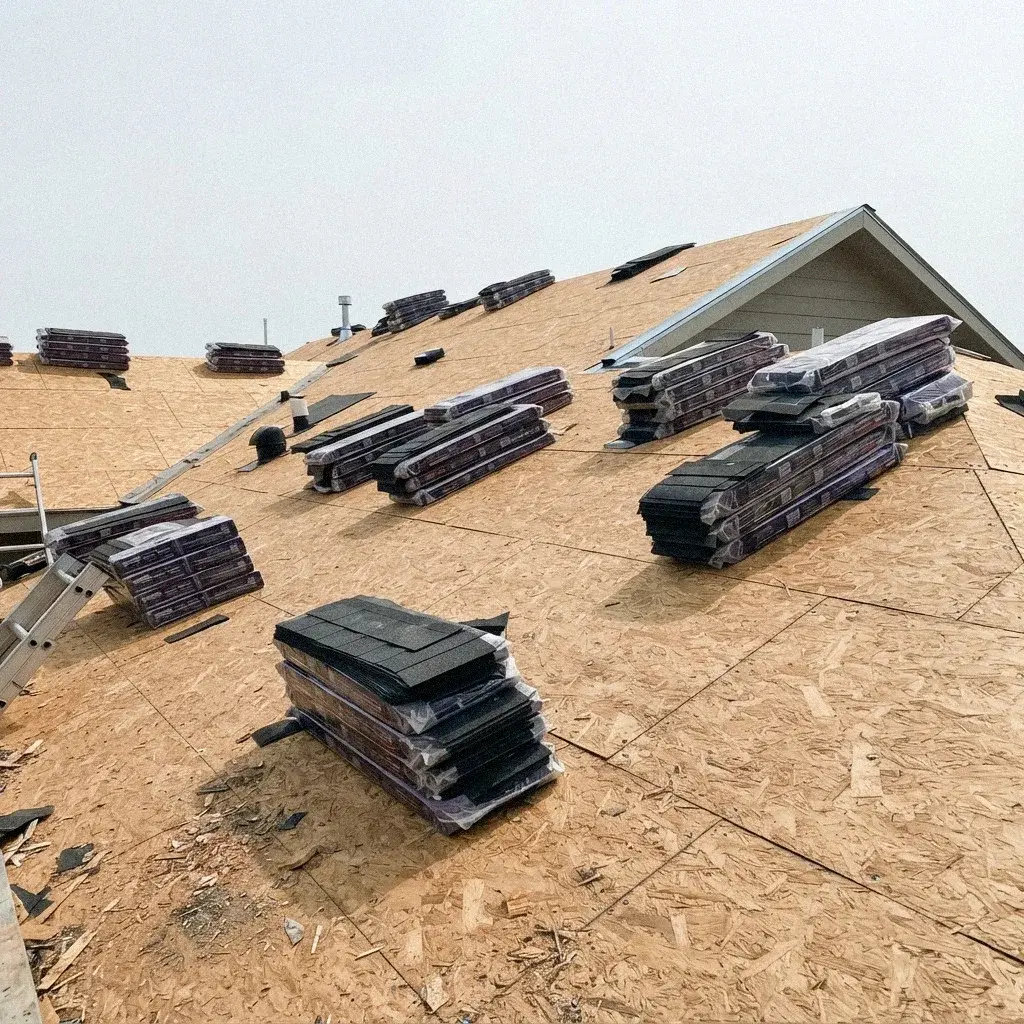
How Roofing Permits and Code Rules Work in Bellevue, WA
What triggers a permit, who pulls it, and the code items that apply whether or not one is issued.
A Bellevue reroof does not automatically require a building permit. The city exempts recovers under a 5 percent weight increase and replacements where sheathing repair stays within five sheets. Above those limits, or on multi-unit buildings, a permit and inspections are required.
When a Roofing Job Triggers a Permit
Permit requirements in Bellevue turn on category of work, not on square footage or price. A recover that leaves the old layer in place is treated differently than a replacement that strips the deck down to bare sheathing near Wilburton or out toward Lake Hills. Sheathing count, weight added, and whether the building is a single-family house or a multi-unit property near the 148th Avenue NE corridor all push the same job in different directions under the city's own roofing policy.
A recover in Bellevue needs no building permit unless the added roofing increases the total weight of the roof by more than five percent. A tear-off and replacement on a single-family house needs no permit if the sheathing being repaired or replaced stays within five 4-by-8 sheets. Cross either threshold and a permit is required. This means a straightforward reroof on a house near Bridle Trails or out toward Somerset can often proceed without a permit, while a job that uncovers rotten decking on the same street may not.
Permit or not, building and energy code requirements still apply to the work itself. Bellevue's own policy is explicit on that point: the absence of a permit does not mean the absence of code. Fastening, underlayment, flashing, and ventilation rules do not relax because no inspector is scheduled to show up. The permit question and the code compliance question are separate, and a homeowner in Wilburton or Factoria who skips the first one has not skipped the second.
Plan Review and Who Pulls the Permit
When a permit is required, the registered contractor performing the work typically applies for it, and Bellevue states it cannot issue a building permit without verifying that contractor's registration is current. The contractor registration number gets printed on the permit itself, which is one reason a homeowner should expect to see that number on a bid before signing anything. Applications, fee payment, and inspection scheduling for Bellevue projects run through the regional portal MyBuildingPermit.com, with inspections also schedulable by phone.
Plan review on a straightforward reroof is usually light compared to new construction, since the scope is a covering and substrate rather than a structural redesign. Where a permit is triggered, the specific inspections that apply are the ones listed on the issued permit, and Bellevue recommends confirming them with the assigned inspector, sometimes at a preconstruction meeting. There is no single inspection sequence that applies to every reroof in every part of the city; the permit document itself is the reference.
- Bellevue draws its own line for recovers, separate from the state layer rule: adding a new layer over existing roofing needs no permit unless the extra material makes the finished roof more than five percent heavier than before.
- A full roof replacement, where the old roof comes off and damaged sheathing gets repaired, skips the permit only if the repaired or replaced sheathing on a house stays within five 4-by-8 sheets. Go past that and a permit applies.
- Commercial buildings get the same recover and replacement structure, but the sheathing exemption is tighter: two 4-by-8 sheets instead of five. A Factoria retail building and a Bellevue Way house are judged by different sheathing counts.
- Multi-unit residential buildings follow a separate path. State law treats roofing as building enclosure work, and rehabilitative construction over five percent of the building's assessed value needs enclosure documents and an enclosure inspection before any permit issues.
- Building and energy code requirements still apply even when no permit is required. A homeowner near Bridle Trails skipping the permit on a small reroof is not skipping the underlayment, flashing, or ventilation requirements that come with it.
- The registered contractor doing the work typically applies for the permit through the regional MyBuildingPermit.com portal. Bellevue prints the contractor's registration number on the permit and cannot issue one without verifying that registration first.
Inspection Stages From Rough to Final
For a permitted reroof, the inspections generally track the stages where the roof is most exposed. An underlayment inspection typically applies before roof coverings go down on low-slope sections, since underlayment is the last line of defense before the covering itself. Where sheathing has been fully removed or added over old skip sheathing, a nailing or progress inspection covers that work before any roofing material goes on top of it, because fastening into replaced or added decking cannot be verified once it is buried.
A final inspection closes out the permit and results in the inspection card being signed off, which is what allows the city to issue a certificate of completion where one applies. Skipping a required inspection, or covering work before an inspector has signed off on it, is one of the more common ways a permitted job goes sideways. On a house near Enatai or Meydenbauer Bay, an inspector who cannot verify fastening under a new layer of shingles has no way to close the permit cleanly.
- Two layers of roof covering is the practical ceiling. State residential code requires tear-off to the deck on replacement, with a narrow exception for an ice barrier membrane that can stay and be covered rather than removed.
- A recover over an existing layer is allowed only under specific conditions, and it is barred outright if the existing roof is water soaked, deteriorated, slate or tile, or already carries two applications of any roofing type.
- In plain terms: a second layer over the first can be fine on a Somerset or Newport Hills house, but once two applications already exist, the only legal next step is a full tear-off, not a third layer on top.
- Fastener schedule, underlayment requirement, and attic ventilation requirement are code-driven regardless of layer count. Nailing pattern, underlayment type on low-slope sections, and intake and exhaust venting are checked whether the job needed a permit or not.
Layer Limits and Core Code Requirements
Washington's residential code sets the layer limit that governs recovers statewide, and it is stricter than most homeowners expect. Existing roof covering generally has to come off down to the deck when a roof is replaced, with a narrow exception for an existing ice barrier membrane that can stay in place under a new one. A recover over an existing covering is allowed in limited circumstances, but never where the existing roof is water soaked, deteriorated, or already carries two or more layers of any covering.
In practice this means a second layer over an existing composition shingle roof can sometimes be legal, but a third layer is not, regardless of what a homeowner near Crossroads or Lake Hills might have seen on an older house. Once two applications are present, the job becomes a full tear-off. Bellevue's own weight-based trigger for recovers sits on top of this state layer rule, so a recover that is otherwise allowed can still cross into permit territory if it adds enough weight.
| Work Type | Permit Trigger | Typical Limit |
|---|---|---|
| Roof recover, no weight added | Usually exempt | Energy code items can still apply |
| Recover adding over 5% weight | Permit required | Weight threshold, not material type, decides it |
| Tear-off, sheathing within local limit | Often exempt | Sheathing sheet count is the deciding factor |
| Tear-off, sheathing beyond local limit | Permit required | Plan review and inspections follow |
| Multi-unit building enclosure work | Permit required | Separate enclosure documents and inspection apply |
HOA Approval and Unpermitted Work at Resale
Fastener schedules, underlayment requirements, ventilation requirements, and flashing requirements are code-driven regardless of whether a permit was pulled. Fastening determines how well a roof covering resists wind, which matters most during the Pacific frontal storms that move through the region in fall and winter. Underlayment is what keeps a roof watertight during the weeks between the old covering coming off and the new one going down, which is a longer exposure window than most homeowners picture.
Ventilation requirements govern how attic space exchanges air, which affects moisture buildup more than heat here, since Bellevue's climate produces long damp stretches rather than extreme summer temperatures. Flashing requirements cover the valleys, chimneys, skylights, and wall intersections where a roof is most likely to leak, and these are the details that separate a roof that lasts from one that fails early. None of these requirements loosen on a job that happens to fall under the no-permit threshold.
HOA Review and Historic Districts
HOA architectural approval is a separate process from city permitting, and one does not substitute for the other. A homeowner in a covenanted subdivision may need sign-off from an architectural review committee on roofing material, color, or style before work starts, even on a job that needs no city permit at all. Historic district review works the same way where it applies: it is a design and materials check layered on top of, not instead of, whatever the city requires.
Unpermitted work surfaces most often at resale, when a buyer's inspector or the title process turns up roofing that should have had a permit and did not. Bellevue's policy of issuing a permit only to a verified, registered contractor also means the permit holder of record becomes part of the property's paper trail, which matters if a warranty dispute or a future sale raises questions about who did the work. A homeowner selling a house near Newport Hills or the Lake Hills Greenbelt is better off with that trail intact than without it.
Permit Facts at a Glance
- Inspection stages on a permitted Bellevue reroof are whatever is listed on the issued permit itself, sometimes confirmed at a preconstruction meeting. A rough or nailing inspection and a final inspection are the common pattern regionally.
- A nailing or progress inspection typically happens before roofing material goes down where the old roofing is fully removed and sheathing is replaced or added over skip sheathing, common on older cedar shake homes near Enatai.
- An underlayment inspection commonly applies before roof coverings go on low-slope sections, roughly 2:12 pitch or flatter, which shows up on some mid-century flat-roofed homes scattered through West Bellevue and Wilburton.
- The final inspection closes out the permit and clears the way for a certificate of completion. The permit holder of record, usually the registered contractor, is who the inspector's findings and the inspection card get tied to.
- HOA architectural approval and historic district review are separate from city permitting entirely. A house near Lake Hills Village under a homeowners association may need sign-off on materials or color before work starts, permit or not.
- Unpermitted work surfaces at resale. A past reroof done without a required permit, based on the sheathing or weight thresholds, can complicate financing, disclosure, or insurance when the Bellevue house eventually sells.
Frequently Asked Questions
Do I always need a permit to replace a roof?
Bellevue's Development Services Department decides this by the numbers, not by feel. A recover over existing material needs no permit unless it adds more than 5 percent to the roof's weight. A full tear-off needs no permit if the deck patch stays at five sheets or fewer. Cross either line and a permit is required, with code and energy rules applying regardless.
Who is responsible for pulling the roofing permit?
The registered contractor performing the work normally applies for the permit and becomes the permit holder of record. Bellevue's Development Services Department states it cannot issue a building permit without confirming the contractor's registration status, and it prints the contractor's registration number directly on the permit. If no permit is required, such as a compliant recover or a small replacement under the sheathing limit, there is no permit holder because none is triggered.
How many layers of shingles can a roof legally have?
A full tear-off and replacement on a house near Bellevue Way or up in Somerset stays permit-free only if the sheathing being repaired or swapped out stays at five 4-by-8 sheets or fewer. Go past that count and Development Services requires a permit before work resumes, regardless of how small the rest of the job is.
What happens at a roof inspection during the job?
No. Bellevue's building and energy code requirements apply to a reroof whether or not a permit was actually issued for it. A permit-exempt job on a Clyde Hill or Newcastle home still has to meet the same fastening, underlayment, and insulation rules an inspector would check if paperwork existed.
Does HOA approval replace the city permit process?
Ask the contractor directly and check the permit record through MyBuildingPermit.com if one was pulled. For an exempt job, request the sheathing count and material specs in writing, since that is what determined the exemption. A homeowner near Enatai or Wilburton should not assume city sign-off happened just because inspectors never showed up.
Wondering if your reroof needs a permit?
Not sure if your reroof needs a permit or just meets code either way? Talk to the licensed pros we connect you with.
Call (425) 380-0932