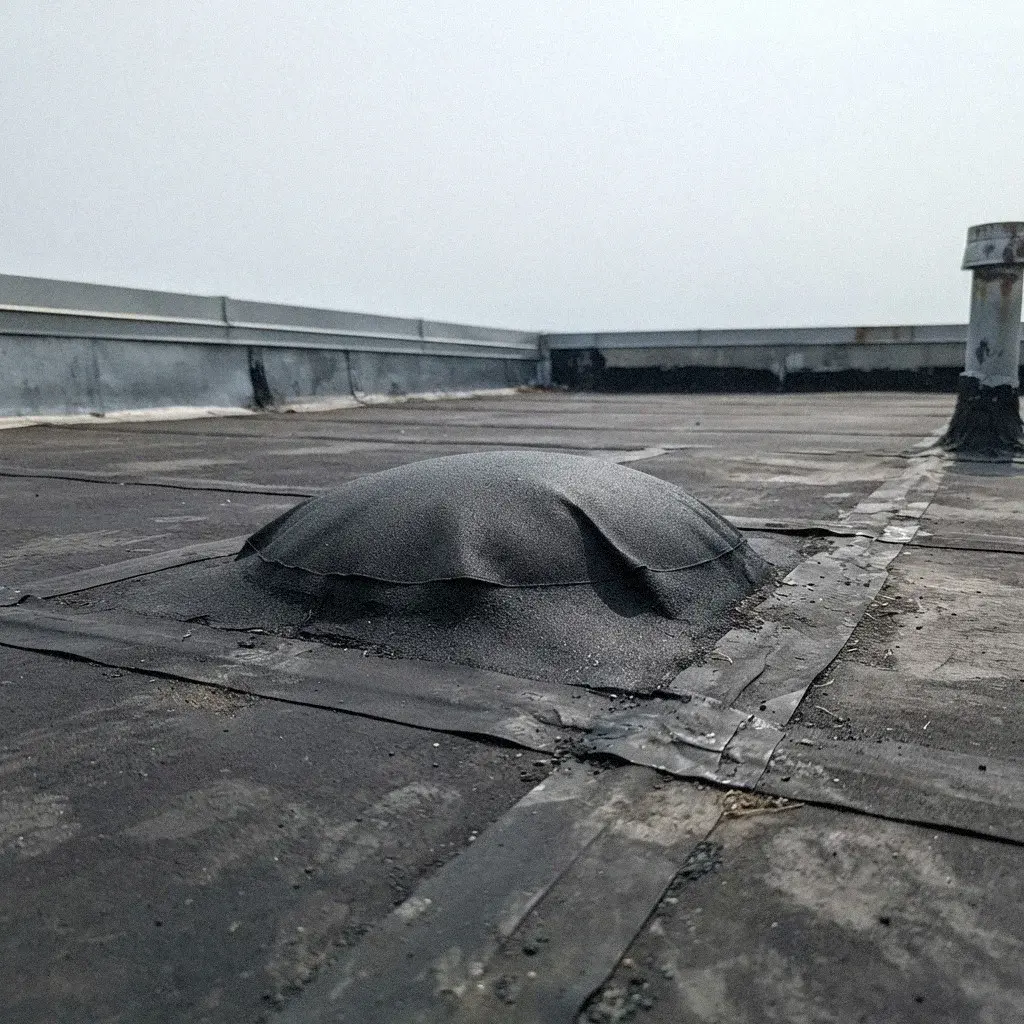
Low-Slope Roof Systems for Bellevue Buildings
How TPO, PVC, EPDM, modified bitumen, and coatings hold up on Bellevue's flat and low-slope roofs.
Low-slope roofs in Bellevue use membranes like TPO, PVC, EPDM, or modified bitumen instead of shingles, because water needs a sealed surface rather than a steep runoff path. Choice depends on the flat roof's drainage, insulation needs, and how the deck was built.
Membrane Options Compared
Bellevue has more flat and low-slope roofs than most people notice, sitting on mid-century modern homes near Somerset and Bridle Trails and on commercial buildings from Factoria to Crossroads. These systems do not shed water by gravity alone the way a steep composition shingle roof does, so the membrane, the seams, and the drainage design all carry more of the load. TPO membrane, PVC membrane, EPDM, modified bitumen, and built-up roofing are the common choices, and each behaves differently once the long wet season sets in.
The choice between these systems usually comes down to how the roof is attached and what sits under it. A membrane can be fully adhered, mechanically attached, or held down as a ballasted system, and each method changes how the roof handles wind uplift, foot traffic, and thermal movement over a building's life. Cover board and tapered insulation sit beneath the membrane on most modern installs, shaping both the roof's insulating value and its ability to move water toward drains instead of holding it.
None of this is decorative work. A low-slope roof over a Bellevue building near I-405 or along Coal Creek Parkway takes on months of overcast, drizzly weather with little drying time between storms, so seam quality and slope toward drainage matter more here than in a drier climate. This page walks through the systems, the attachment methods, the insulation layers, the details around penetrations, and how long each combination tends to hold up.
Attachment and Insulation Choices
TPO membrane is a single-ply sheet, usually white or gray, that is hot-air welded at the seams rather than glued or taped. It has become a common choice on newer commercial low-slope roofs around Bellevue's Eastgate and Wilburton areas because it is lightweight, reflects heat, and welds into a continuous sheet that resists standing water better than older built-up systems. PVC membrane is a close cousin, also hot-air welded, with better resistance to oils and chemical exposure, which matters more on some restaurant and light-industrial roofs than on typical office buildings.
TPO and PVC membranes dominate new installs because hot-air welded seams outperform adhesives in a climate where surfaces rarely dry completely. EPDM still turns up on older Bellevue buildings, seamed with adhesive rather than welding. Modified bitumen and built-up roofing remain common on multifamily stock near Wilburton and Factoria. Fully adhered and mechanically attached systems both work here; ballasted assemblies need a deck that can carry the ballast weight, which matters on older framing.
- TPO membrane arrives in wide sheets and is usually mechanically attached or fully adhered over cover board. Its heat-welded seams resist the standing water that collects on the flat and mid-century modern roofs common around Bellevue and Clyde Hill.
- PVC membrane shares TPO's welded-seam approach but holds up better against grease and chemical exposure, which matters more for commercial kitchens near Crossroads or Factoria than for a typical Bellevue house roof.
- EPDM is a rubber sheet, black or occasionally white, joined with adhered seams rather than welds. It has a long track record on flat residential additions and older low-slope sections tucked under conifer canopy in Bridle Trails.
- Modified bitumen is a reinforced asphalt sheet, torch-applied, hot-mopped, or self-adhered, and it shows up often on Bellevue's mid-century flat-roofed homes as the layer beneath a later membrane conversion.
- Built-up roofing layers asphalt and ply sheets into a single mass, finished with gravel or a coating. It is heavier and older technology, mostly found on legacy commercial low-slope roofs rather than new installs.
- Roof coatings are a maintenance layer, not a standalone system. They restore UV resistance and seal minor seams on an aging membrane, buying years before a full recover or tear-off is needed.
Seams, Terminations, and Drainage
Modified bitumen and built-up roofing are older, heavier systems still found on commercial buildings and some houses around Bellevue, often layered with asphalt and reinforcing sheets rather than a single membrane sheet. Built-up roofing uses alternating layers of asphalt and felt to build a thick, multi-ply surface, while modified bitumen uses factory-made sheets reinforced with polymers and is typically torch-applied, hot-asphalt applied, or self-adhered. Both hold up well under foot traffic and gravel ballast but add significant weight, which matters when a building near Factoria or Northeast Bellevue is being evaluated for a recover instead of a full tear-off.
Roof coating is a maintenance and extension option rather than a full roofing system on its own. A reflective or elastomeric coating applied over an existing membrane, over modified bitumen, or over built-up roofing can seal minor cracking, slow UV wear, and buy years of service life without the cost of a full replacement. Coatings work best on a roof that is still structurally sound and free of standing water problems, and they are not a fix for a membrane that has already failed at the seams or around penetrations.
- Ballasted systems lay membrane loose over insulation and weight it down with stone or pavers. They need a structure rated for that added dead load, which limits their use on lighter residential framing.
- Fully adhered systems glue membrane directly to cover board or insulation, giving a clean, wind-resistant surface without added weight, which suits most Bellevue low-slope residential and small commercial roofs.
- Mechanically attached membrane is fastened through cover board into the deck at seams, then the next sheet overlaps and welds over the fastener line, balancing wind holding power with lighter overall weight.
- Tapered insulation builds slope into a roof that has none structurally, directing water toward drains or scuppers instead of letting it pond across the field, which is the root cause behind most low-slope leaks.
Recover Versus Tear-Off
What sits under the membrane matters as much as the membrane itself. Cover board, usually a dense gypsum or fiber-reinforced panel, sits above the insulation and gives the membrane a stable, puncture-resistant surface to bond or weld to. Tapered insulation is cut or fabricated with a slight slope built into the panels, directing water toward drains and scuppers instead of letting it collect in the field of the roof. On a flat commercial roof around Crossroads or the Marketplace at Factoria, tapered insulation is often the difference between a roof that drains cleanly after a storm and one that holds water for days.
Insulation choice also affects the Washington State Energy Code requirements that can apply when a roof cavity is exposed during replacement, since the code sets minimum insulation values for the assembly. Getting the tapered layout wrong, or skipping cover board to save cost, tends to show up later as ponding, membrane fatigue, or a coating that fails faster than expected. These are foundational decisions made before the membrane ever goes down, and they are hard to correct after the fact without significant rework.
| System | Attachment | Service Life |
|---|---|---|
| Dry, sound existing membrane | Recover often possible | Check existing layer count first |
| Wet or saturated insulation | Tear-off required | Recover traps moisture underneath |
| Two prior roof layers present | Tear-off required | State code limits stacked layers |
| Persistent ponding or poor slope | Tear-off with tapered insulation | Recover cannot fix drainage |
| Added weight exceeds 5 percent | Bellevue permit required | City policy sets the threshold |
Service Life and Maintenance
Seam welding is where a TPO or PVC installation succeeds or fails. A hot-air welded seam fuses two membrane sheets into one continuous surface, and the quality of that weld depends on temperature, overlap width, and probing every seam after welding to confirm a full bond. Termination bar secures the membrane's edge at walls, parapets, and curbs, and it has to be paired with proper sealant and fastening to keep wind and water from working the edge loose over years of exposure to Bellevue's winter windstorms.
Roof drain and scupper placement determines whether water actually leaves the roof once it reaches the low points. A clogged or undersized drain backs water up across a low-slope roof fast, and overflow scuppers exist specifically as a backup path so water has somewhere to go if the primary drain fails or a storm outpaces it. Curbs around rooftop equipment, pitch pans around pipes and conduits, and walkway pads protecting the membrane from foot traffic during maintenance are the recurring detail points where low-slope roofs actually leak.
Choosing Between Recover and Tear-Off
Deciding between recover and tear-off starts with what is under the existing membrane. A recover goes over sound, dry insulation and skips demolition cost, but it hides any wet insulation instead of solving it, and a second membrane layer changes how the roof handles ponding at drains and scuppers. Tear-off costs more upfront yet lets a contractor correct slope with tapered insulation, replace a soaked cover board, and reset flashing at every curb and pitch pan. Bellevue's own weight-based recover rule is a separate question from which approach actually serves the building.
Service life varies by system and by how well the details were executed rather than by brand alone. EPDM and built-up roofs have a long track record in this climate when seams and flashings are maintained, TPO and PVC depend heavily on weld quality, and modified bitumen sits somewhere between the two depending on the application method used. On any of these systems, a Bellevue building's actual lifespan comes down to drainage design, seam integrity, and how quickly small problems at curbs, pitch pans, and terminations get caught before the long wet season turns them into leaks.
Membrane Options at a Glance
- Roof drains and scuppers move water off a flat roof; overflow drains or secondary scuppers set slightly higher are the backup if the primary path clogs with fir needles from the canopy common around Bellevue.
- Pitch pans are metal boxes filled with sealant around pipes and small penetrations. They are a known failure point and need periodic resealing rather than being treated as a permanent fix.
- Walkway pads protect the membrane where foot traffic concentrates near rooftop units or access hatches, spreading load and resisting the puncture and wear that unprotected membrane can't take.
- Termination bars anchor membrane edges at walls, curbs, and parapets, and a hot-air welded seam at the field joints is what actually keeps the water out between those termination points.
- Recover means adding a new membrane over sound existing roofing; tear-off means stripping to the deck. A waterlogged or already-layered low-slope roof usually forces tear-off regardless of preference.
- Service life varies by material and installation quality, but low-slope membranes generally run shorter than a well-installed steep-slope composition shingle roof, which is why inspection intervals matter more here.
Frequently Asked Questions
How long does a flat roof last here?
Bellevue draws that line by weight, not by whether the job looks routine. Installing a new membrane over the old one is exempt from a building permit unless the added material pushes the roof's total weight up by more than 5 percent, which can happen with a heavier coating system or a second layer of modified bitumen. A tear-off that replaces the deck avoids a permit only if the sheathing swap stays within a small sheet count. Call Bellevue's Development Services Permit Center to confirm before work starts.
Can you recover my flat roof or does it need tear-off?
TPO and PVC use hot-air welded seams, which fuse the sheets into one continuous surface rather than relying on adhesive alone. EPDM seams are typically adhered with tape or liquid adhesive instead of welded, which is a real difference in long-term seam reliability.
Why does my flat roof pond water?
Recover means installing new roofing over the existing membrane, which works when the old surface is sound and dry. Tear-off removes everything down to deck or insulation, needed when there's wet insulation, multiple existing layers, or membrane failure. A licensed pro we connect you with can assess a Bellevue roof and recommend which applies.
What is the best membrane for a Bellevue flat roof?
TPO and PVC membranes are typically fully adhered or mechanically attached and generally run 20 to 30 years with proper seam welding and maintenance. EPDM often lasts longer in ballasted systems. Built-up roofing and modified bitumen can also reach 20-plus years. Bellevue's wet season makes drainage detailing and coating maintenance the bigger factor in actual service life.
Do coatings actually extend a roof's life?
Coatings extend the life of a sound membrane by renewing UV and weather resistance, but they don't rebuild drainage or fix failed seams. They're a maintenance step, not a substitute for recover or tear-off when the membrane is already compromised.
Ready to compare low-slope roof options?
Get a low-slope roof evaluated by the licensed pros we connect you with before the next wet season sets in around Bellevue.
Call (425) 380-0932