Bellevue homeowners looking at a metal roof, whether on a Somerset hillside home or a mid-century flat-roofed house near Wilburton, usually run into two different families of panel without realizing they're different systems. One hides its fasteners under a raised seam. The other drives screws straight through the panel face. That single difference in how the panel attaches to the deck changes how the roof handles the region's long wet season, how it looks after a few years, and where each one tends to show up around the city.
What Standing Seam Actually Means
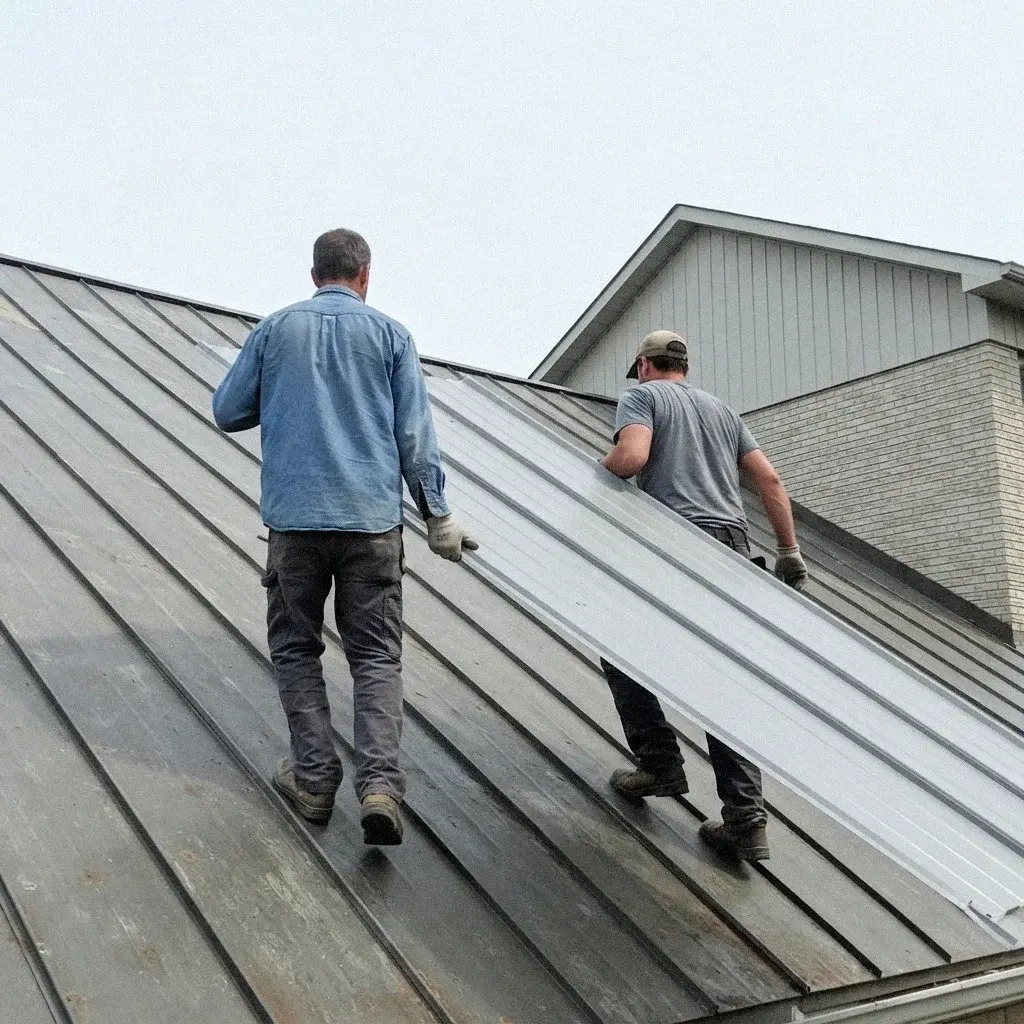
Standing seam describes a metal roof made of long panels joined by raised, vertical seams running from ridge to eave. The seam itself is the identifying feature: a folded or interlocked rib where two panel edges meet, standing up above the flat part of the panel. No fasteners show on the finished surface anywhere on the field of the roof. Around Bellevue you'll spot this on newer construction and some remodeled homes near Enatai and West Bellevue, where the clean, unbroken look is part of the appeal.
The Concealed Clip Underneath
Panel gauge and rib design both influence how visible thermal movement becomes over time. Thinner gauge panels flex more as temperatures shift through a Bellevue day, and that flex shows up as a rippled reflection along flat pan areas between ribs. Concealed-clip systems allow the panel to slide slightly beneath the seam, which absorbs that movement quietly. Exposed-fastener panels have less give, since each screw pins the panel at fixed points, so any distortion tends to gather near the fastener rows instead of spreading evenly across the sheet.
Snap-Lock Versus Mechanically Seamed
Not all standing seam is joined the same way. A snap-lock seam clicks together by hand or with a hand tool, and it's the simpler, faster version to install. A mechanically seamed roof gets its seam folded and crimped by a motorized seaming tool after the panels are in place, producing a tighter, more weathertight joint. Mechanically seamed roofs generally handle lower slopes and higher water exposure better, which is one reason they turn up on flatter roof sections around Bellevue's older mid-century homes.
What an Exposed-Fastener Panel Looks Like
An exposed-fastener panel is the opposite approach: screws go straight through the panel face at set intervals, usually into the rib or the flat pan between ribs, and stay visible on the finished roof. R-panel and corrugated panel are the common profiles in this category, identified by their repeating ribs or wave pattern across the sheet. You can tell one from standing seam at a glance just by looking for the screw heads dotting the surface, something a standing seam roof never shows.
Neoprene Washers Are Doing the Work
On an exposed-fastener roof, every one of those visible screws relies on a neoprene washer screw to keep water out at the point where metal has been punctured. The washer compresses against the panel to seal the hole. That seal is a wearing part, not a permanent one, and it's the single detail that decides whether an exposed-fastener roof stays watertight through repeated Bellevue rain seasons or starts leaking at scattered points across the field years before the panel itself would fail.
Thermal Movement Changes the Math
Metal panels expand and contract with temperature swings, and that thermal movement plays out differently depending on how the panel is fastened. Standing seam panels float under their concealed clips, free to move lengthwise without stressing a fastener. Exposed-fastener panels are pinned rigidly at every screw, so the panel itself has to flex around fixed points. Over enough cycles, that fixed-point stress is what eventually enlarges the screw hole and works the washer loose.
Reading Oil Canning on a Roof
Oil canning is the wavy, rippled distortion you sometimes see across the flat pan of a metal panel, most visible at a low sun angle. It comes from minor waviness in the metal itself interacting with thermal movement and panel gauge, and it's more of a cosmetic issue than a performance one. Standing seam panels, with wider flat pans between ribs, tend to show it more noticeably than R-panel or corrugated profiles, where frequent ribs break up the flat area and hide minor waviness.
Panel Rib and Seam Height Differences
Look at the raised profile itself and you can usually sort the two families without any other clues. Standing seam ribs are tall, at the panel edges only, and vertical from one seam to the next with nothing in between. Exposed-fastener panels like R-panel have shorter, evenly spaced ribs running across the whole panel width, with the fastener screws visible right on those ribs or in the pan beside them. Seam height and rib spacing are the two measurements installers use to describe either system precisely.
Closure Strips at the Edges
Both systems need closure strips, foam or rubber pieces shaped to match the panel profile, wherever the panel meets a ridge, eave, or wall. The strip fills the gaps left by the panel's ribs so wind-driven rain and debris can't work up underneath at those transition points. Exposed-fastener panels, with their more pronounced corrugation, typically need a more precisely fitted closure strip than the tighter seam profile of standing seam, since there's more open rib shape to seal at each edge.
Where Each System Tends to Fit
Standing seam shows up more often on architecturally driven projects, low-slope sections, and homes where the owner wants a smooth, seamless look, including some of the flat-roofed mid-century houses scattered around Bellevue. Exposed-fastener panels turn up more on secondary structures, outbuildings, and budget-driven metal reroofs, since the panel and install are generally simpler. Neither is wrong for a house; the decision usually comes down to roof slope, panel gauge, and how much the owner minds a visible fastener pattern.
Spotting the Difference From the Ground
From the street, the fastest tell is the seam. If you see a raised vertical rib with no visible screws anywhere on the flat panel, that's standing seam, concealed clip and all. If you see evenly spaced screw heads running down every rib or pan, that's an exposed-fastener panel, whether it's an R-panel or a corrugated profile. Once you know to look for the fastener rather than the panel shape alone, telling the two apart on any Bellevue roof takes about five seconds.
Dealing with this in your home?
Bellevue roofs age on their own schedule. Wooded lots near Bridle Trails and Somerset stay shaded long after storms pass, and conifer cover keeps surfaces from ever fully drying between fronts. Add a reroof window that tightens once summer ends, and small maintenance calls turn urgent fast. The sections below sort out timing, materials, and who actually answers for the work overhead.